We get the same call almost every August. A homeowner over in Kings Ridge, Heritage Hills, or one of the older subdivisions off Hancock Road calls in because their Duke Energy bill jumped $150 in two months, the AC sounds the same as it always has, the thermostat hasn't moved, and they cannot figure out why.
Most of the time, the answer is sitting in the attic where almost nobody ever looks. Lake County summers are punishing. Clermont's elevation puts more sun on the roof than most of Florida sees, and the local housing stock was built across four very different construction eras, each with its own quirks in insulation, ductwork, and envelope tightness.
This is what we've learned from years of service calls across Lake County: the biggest wins on a Clermont electric bill aren't found in thermostat settings or filter brands. They're found in five or six specific upgrades, in a specific order, starting with the part of the house we just mentioned. For many homeowners, the foundation of those improvements begins with top insulation installation near Clermont FL, where proper attic insulation and air sealing can dramatically improve comfort, reduce HVAC strain, and lower long-term cooling costs in Florida’s demanding climate.
TL;DR Quick Answers
top insulation installation near Clermont FL
Top insulation installation in Clermont FL means R-38 or higher attic insulation matched to Florida Building Code climate zone 2, Duke Energy-qualified contractor status for rebate eligibility, and a Florida DBPR-verified license. Most Lake County homes built before 2000 still run at R-11 to R-19 and benefit immediately from the upgrade.
What to look for:
R-value match to Florida Building Code climate zone 2: R-38 minimum for new construction, R-49 widely accepted as the practical retrofit target across Lake County
Duke Energy-qualified contractor status: required for Home Energy Improvement rebate eligibility on the install
Florida DBPR licensed: verify any contractor at myfloridalicense.com before signing
Local housing-era familiarity: experience with Kings Ridge, Heritage Hills, Summit Greens, and the older subdivisions where settled insulation is common
Pre-install attic assessment: measurement of existing R-value, identification of gaps around recessed lighting and HVAC platforms, and a written scope before work begins
Top Takeaways
Clermont's elevation in peninsular Florida and its year-round cooling load make attic insulation the highest-ROI energy upgrade for most Lake County homes.
Florida Building Code climate zone 2 requires R-38 attic insulation for new construction. Most pre-2000 subdivision homes in Clermont are running at R-11 to R-19 after years of settling.
ENERGY STAR estimates 20 to 30 percent of conditioned air is lost to duct leaks in a typical home, and Clermont's 130 to 140°F summer attic temperatures make those losses more expensive than the national average.
Duke Energy Florida offers up to $3,800 in Home Energy Improvement rebates across attic insulation, duct work, HVAC replacement, and water heaters for customers who complete a free Home Energy Check first.
HVAC equipment accounts for over 40% of total energy use in a typical Florida home according to University of Florida IFAS Extension data, which is why every other efficiency upgrade compounds against your HVAC envelope.
Why Clermont Energy Bills Run Higher Than You'd Expect
A few different forces stack up in Lake County that don't stack the same way for our neighbors on the coast. We sit at the highest elevation in peninsular Florida, so the roof gets longer daily sun exposure than most of the state. The Chain of Lakes traps humidity through the long shoulder seasons, which means “cooling-only” time stretches from March through November in most years. And the housing stock here spans four distinct construction eras: older homes near downtown and Lake Minneola, 1980s and 1990s subdivisions, post-2000 master-planned communities like Kings Ridge, Heritage Hills, and Summit Greens, and newer builds going up along the Hartwood Marsh corridor. Each era brought its own baseline insulation, its own duct design, and its own envelope tightness.
The other factor is runtime. Florida HVAC systems run year-round. There is no cooling-only or heating-only season the way northern states have. According to data from the University of Florida IFAS Extension, HVAC equipment accounts for over 40% of a typical Florida home's energy use, which is more than any other appliance, system, or fixture in the house. Small inefficiencies (a duct leak, a settled batt of insulation, a thermostat set two degrees too cool) end up compounding across every hour of every day, which is why many homeowners turn to a top attic insulation service to improve energy efficiency and reduce long-term cooling costs.
Tip 1: Upgrade Attic Insulation
Of all the efficiency projects available to a Clermont homeowner, this is the one that pays back fastest and most reliably. We say that not because attic insulation is exciting (it isn't) but because in our experience working on Lake County homes, it's the single move that shows up on the next Duke Energy bill more visibly than anything else we touch.
Florida's Building Code places Lake County in climate zone 2 (warm-humid), which requires a minimum R-38 attic insulation for new construction. The U.S. Department of Energy recommends R-30 to R-60 for attics in this zone, with R-49 widely considered the practical sweet spot for retrofit work.
Most older Clermont homes have far less than that. We routinely measure 1980s and 1990s subdivisions running at R-11 to R-19 once the insulation has settled and matted down. Even some post-2000 master-planned community builds came in at code-minimum and haven't been touched since the family moved in. Bringing an attic from R-19 up to R-38 or higher reduces the cooling load directly, because less heat is conducting through the ceiling plane in the first place.
For most Lake County houses, this work pays back within a few years, and Duke Energy's Home Energy Improvement rebate program offsets a meaningful portion of the install cost for qualifying homes. For the full details on R-value targets, install warranty terms, and how the Duke Energy rebate process actually works in this market, our top insulation installation near Clermont FL page covers all of it.
Tip 2: Seal and Repair Your Air Ducts
After insulation, the ductwork running through that same attic is the next bottleneck. ENERGY STAR estimates that roughly 20 to 30 percent of the air moving through a typical home's duct system is lost to leaks, holes, and poor connections. In Clermont, that loss is often worse than the national average, and the reason is straightforward: most pre-2000 subdivision homes here run flex duct through attic spaces that hit 130 to 140°F in summer. Conditioned air leaving the supply trunk at 55°F has to fight a 75-to-85-degree temperature differential the entire way to the supply register. Every gap, every loose collar, every joint where the original mastic has dried and cracked is conditioned air leaking into your attic instead of your bedroom.
We see this constantly on service calls in older Kings Ridge and Citrus Tower-area homes where the original 1990s duct mastic has long since dried out and the joints have separated. Even a partial reseal, done correctly, usually drops HVAC runtime measurably within the first billing cycle. Duke Energy offers a separate rebate for duct test and repair work performed through their qualified contractor network.
Tip 3: Maintain Your HVAC System
Two service visits a year is the cadence we recommend for every Florida home: one in spring before the heavy summer cooling load lands, one in fall before the short winter heating season. Each visit should cover the coil cleaning, the refrigerant charge check, the drain line inspection, the blower motor, and the filter situation.
About filters: the standard schedule that came in your HVAC manual probably assumed a milder climate than ours. Clermont air is a different animal. We have oak pollen in spring, cottonwood seeds in early summer, and year-round humidity that loads up a one-inch filter faster than the same filter would clog in Atlanta or Charlotte. For homeowners running standard MERV 8 to 11 filters, we tell them to plan on every 60 days at the latest, and every 30 days during the peak pollen weeks of March and April.
Tip 4: Take Advantage of Duke Energy Programs and Rebates
Duke Energy Florida runs a Home Energy Improvement rebate program that can return up to $3,800 in incentives across attic insulation, duct sealing, HVAC replacement, energy-efficient windows, and heat pump water heaters. There is one requirement up front: a free Home Energy Check, which is a phone-based or online energy assessment that establishes the baseline conditions in your home. The whole thing takes under an hour.
The EnergyWise Home program is separate but complementary. Enrolled homeowners earn bill credits during peak demand events, which adds up to roughly $141 in annual credits for a typical participant. For homes that already run the AC hard during summer afternoons, the math tends to work in the homeowner's favor.
Tip 5: Use Smart Thermostats and Zoning
A smart thermostat alone will not transform a Clermont electric bill. Combined with the upgrades above, though, it captures the last layer of available savings. ENERGY STAR certified models track runtime patterns, anticipate setbacks, and adjust the cooling cycle around your actual occupancy in ways an older programmable thermostat simply cannot.
For the two-story homes that fill out newer master-planned communities like Kings Ridge, Heritage Hills, Summit Greens, and Clermont National, zoning is the real lever. A two-story Florida home running on a single thermostat is almost always over-cooling the downstairs to keep the upstairs from feeling like an attic itself. Adding a zoned damper system with a second thermostat upstairs typically reduces cooling runtime in the unused half of the house during the workday.
Tip 6: Address Pool Pumps, Water Heaters, and Lighting
Outside the HVAC stack, a few other categories are worth knowing about because Lake County homes tend to be pool-heavy and garage-warm. Variable-speed pool pumps replace older single-speed models that run at full draw every minute they're on. The switch alone can cut pool-related electrical consumption by half or more, depending on your runtime schedule. Heat pump water heaters pull warmth from the surrounding air to heat the water tank, which works especially well in Florida garages where the ambient air stays warm year-round. And LED replacements for any remaining incandescent or halogen fixtures pay back inside a year on any bulb running more than a couple of hours a day.
None of these is as transformative as Tip 1 or Tip 2 on its own. Stacked together, they are meaningful.
For background reading on how insulation actually works, the Wikipedia article on building insulation covers the underlying physics, R-value math, and material categories in good detail.
“In Clermont, we see the same pattern across hundreds of summer service calls: a 1990s home with original flex duct running through a 135°F attic, where conditioned air loses 25 to 30 percent of its cooling capacity before it ever reaches the supply register. The homeowner blames the AC, but the duct system is the real culprit.”
Essential Resources
Primary sources for the technical claims in this guide. All .gov, .edu, and .org domains. All URLs verified live at time of writing.
U.S. Department of Energy — Insulation overview and climate zone R-values. energy.gov/energysaver/insulation. The federal reference for recommended R-values by climate zone, insulation material categories, and how heat moves through a building envelope.
ENERGY STAR — Duct sealing benefits and methodology. energystar.gov/saveathome/heating-cooling/duct-sealing. The source of the 20–30% duct leakage figure cited throughout this guide, plus guidance on professional and DIY sealing approaches.
Florida Department of Business and Professional Regulation — Contractor license verification. www2.myfloridalicense.com. The official portal for verifying any Florida contractor's license status, classification, and disciplinary history before hiring.
FSEC Energy Research Center, University of Central Florida — Florida-specific building science research. energyresearch.ucf.edu. Florida's statewide energy research institute since 1975, with peer-reviewed work on Florida cooling loads, radiant barriers, and residential retrofits.
National Renewable Energy Laboratory — Residential buildings research. nrel.gov/buildings. The U.S. DOE national lab publishing research on building envelopes, HVAC efficiency, and residential energy modeling.
U.S. Environmental Protection Agency — Improving indoor air quality at home. epa.gov/indoor-air-quality-iaq/improving-indoor-air-quality. The federal reference for source control, ventilation, and filtration strategies in residential HVAC.
Duke Energy Florida — Home Energy Improvement rebates and Home Energy Check. duke-energy.com/home/products/florida-savings. The utility's rebate hub for attic insulation, duct test and repair, HVAC replacement, energy-efficient windows, and heat pump water heaters in the Florida service area.
Supporting Statistics
Three primary-source data points that frame the scale of the Florida residential energy load. Distinct from the Essential Resources above.
54% of Florida's total electricity is consumed by the residential sector, the largest share of any U.S. state. Source: U.S. Energy Information Administration, Florida State Energy Profile (2023). eia.gov/state/print.php?sid=FL.
Air conditioning accounts for 28% of total site energy use in Florida households, compared with 9% nationally. Source: U.S. Energy Information Administration, 2020 Residential Energy Consumption Survey. eia.gov/pressroom/releases/press535.php.
HVAC equipment accounts for more than 40% of total energy use in a typical Florida home. Source: University of Florida IFAS Extension, Energy Efficient Homes: Air Conditioning. edis.ifas.ufl.edu/publication/FY1026.
These Florida energy statistics reinforce the value of professional attic insulation as one of the most effective upgrades a homeowner can make for long-term comfort and energy efficiency. Because cooling systems operate almost year-round in Central Florida, properly installed attic insulation helps reduce HVAC strain, stabilize indoor temperatures, improve overall system performance, and lower monthly energy costs across Clermont homes.
Final Thoughts and Opinion
After years of seeing the same patterns in Lake County attics, we have come to a simple opinion: the order matters. The biggest single bottleneck in most Clermont homes is the attic itself, both because it gets brutally hot and because most local housing stock was built to baseline insulation specs that the Florida Building Code has since raised. The second bottleneck is the ductwork running through that same attic. Everything else stacks on top of those two.
Homeowners who start with the cheapest moves (smart thermostats, LED bulbs, ceiling fans) usually find their electric bill barely changes. Homeowners who start with the attic envelope tend to see real, visible reductions in their first or second summer billing cycle. Lake County's particular combination of long sun exposure, year-round HVAC runtime, and aging subdivision insulation makes that ordering matter more here than it would in a milder climate.
One more honest opinion: the Duke Energy Home Energy Improvement rebate program is worth the time. The Home Energy Check is free, it takes under an hour, and the rebate stack on attic insulation and duct work offsets a real portion of the upgrade cost. Every Clermont homeowner we work with hears the same advice from us: start there, especially before investing in professional attic insulation installation that can deliver long-term energy savings and improved home comfort.
Frequently Asked Questions
What's the best way to lower energy bills in Clermont FL?
Upgrading attic insulation to R-38 or higher delivers the largest single reduction for most Lake County homes, because Clermont's elevation and long sun exposure put more load on the ceiling plane than coastal Florida sees. After that, sealing duct leaks and tuning the HVAC twice a year produces the next-largest improvements, with smart thermostats and pool pump upgrades stacking on top.
How much can attic insulation save Florida homeowners?
Actual savings depend on existing R-value, attic square footage, ductwork condition, and HVAC efficiency. Homeowners upgrading from baseline R-19 insulation to R-38 or higher in Lake County typically see meaningful reductions within the first summer billing cycle. Duke Energy's rebate program also offsets a portion of the install cost for qualifying homes.
What R-value attic insulation do I need in Central Florida?
The Florida Building Code requires a minimum R-38 attic insulation for new construction in climate zone 2, which covers Lake County and most of Central Florida. The U.S. Department of Energy recommends R-30 to R-60 for this zone, with R-49 widely accepted as the practical retrofit target for older homes with adequate attic space.
Does Duke Energy offer rebates for energy efficiency upgrades?
Yes. Duke Energy Florida's Home Energy Improvement program offers up to $3,800 in rebates across attic insulation, duct test and repair, HVAC replacement, energy-efficient windows, and heat pump water heaters. A free Home Energy Check is required before any work, and rebates apply only when work is performed by a Duke Energy-qualified contractor from their approved network.
How often should I have my HVAC system serviced in Florida?
Twice per year. One service in spring before the heavy summer cooling load, one in fall before the brief winter heating season. Each visit should include coil cleaning, refrigerant charge check, drain line inspection, blower motor check, and filter assessment. Florida HVAC systems run year-round, so the maintenance cadence is more demanding than what manufacturers recommend for milder climates.
Is it worth adding insulation to an older Clermont home?
Almost always, yes. We routinely measure 1980s and 1990s Clermont homes running at R-11 to R-19 attic insulation, which is half or less of the current code minimum. Bringing those homes up to R-38 or higher reduces cooling load directly. The Duke Energy rebate program is structured to favor exactly this upgrade for older housing stock.
How do I find a qualified insulation installer in Clermont FL?
Start at the Florida Department of Business and Professional Regulation license search portal at myfloridalicense.com, where you can verify any contractor's license status, expiration, and disciplinary history. For Duke Energy rebate eligibility, the installer must also be on Duke Energy's approved contractor list. Homeowners comparing options for top insulation installation near Clermont FL should confirm both before signing any agreement.
When is the best time of year to upgrade attic insulation in Florida?
Any time of year works, but homeowners who book the work before summer (March through May) see the savings reflected in the first major billing cycle, which makes the investment math easier to evaluate. Installers also tend to have more scheduling availability in those months than during the peak summer rush.
How to Start Lowering Your Clermont Energy Bill
We have spent years walking Lake County attics and reading Lake County electric bills, and the answer for most Clermont homes starts in the same place: above your ceiling. The shortest path to a lower summer bill is a free Duke Energy Home Energy Check followed by an attic insulation upgrade to current code, and we handle both for homeowners across Clermont.
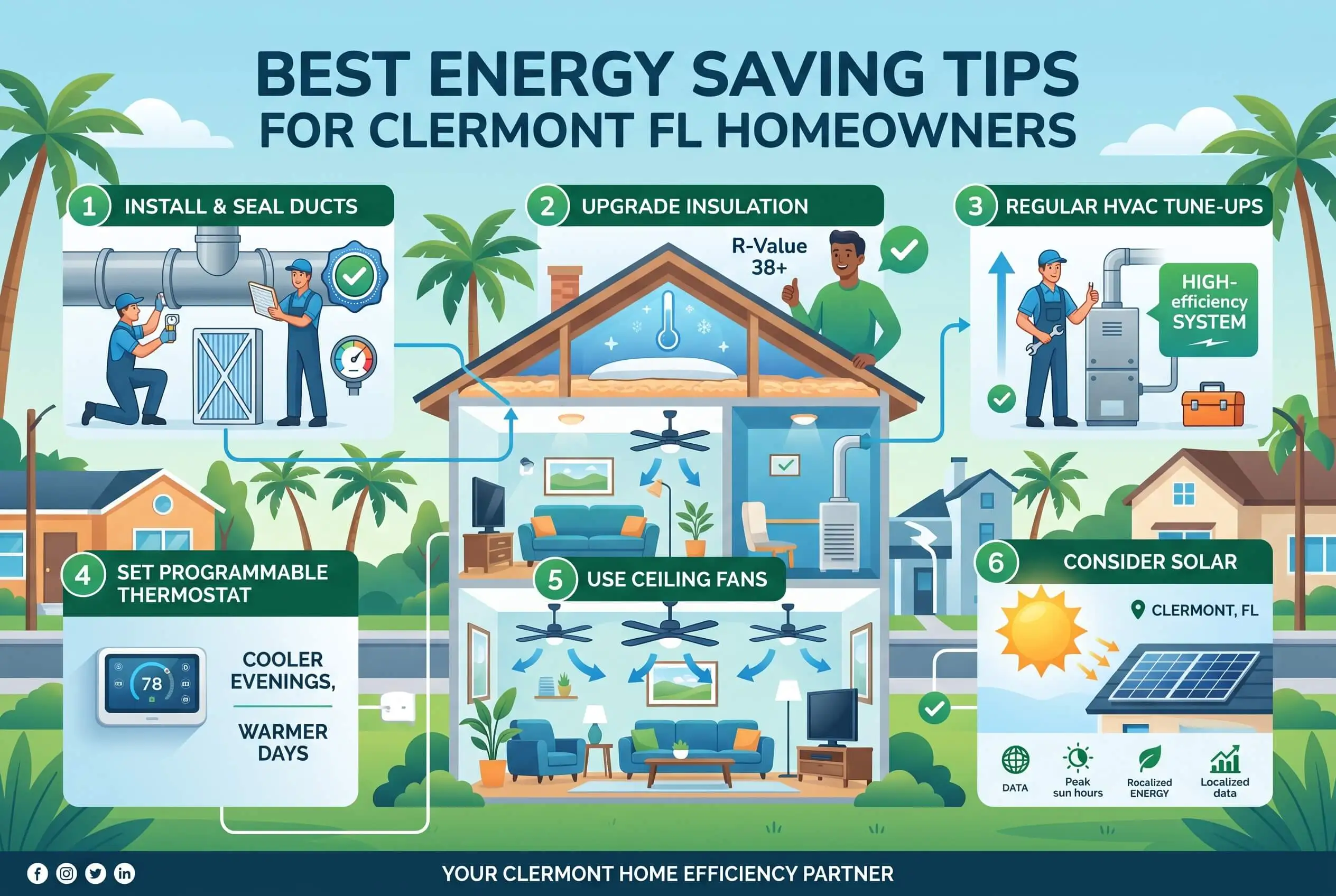
Homeowners exploring best energy saving tips for Clermont FL homeowners often focus on insulation and HVAC efficiency, but consistent airflow maintenance plays an important role in lowering long-term cooling costs as well. Replacing clogged filters with high-quality options like 24x30x1 pleated furnace filters, 15x20x1 MERV 8 HVAC air filters, and pleated AC furnace filters can help HVAC systems operate more efficiently in Florida’s year-round heat. When paired with proper attic insulation and air sealing, clean filtration supports healthier indoor air, steadier airflow, and reduced strain on home cooling systems throughout Clermont homes.
