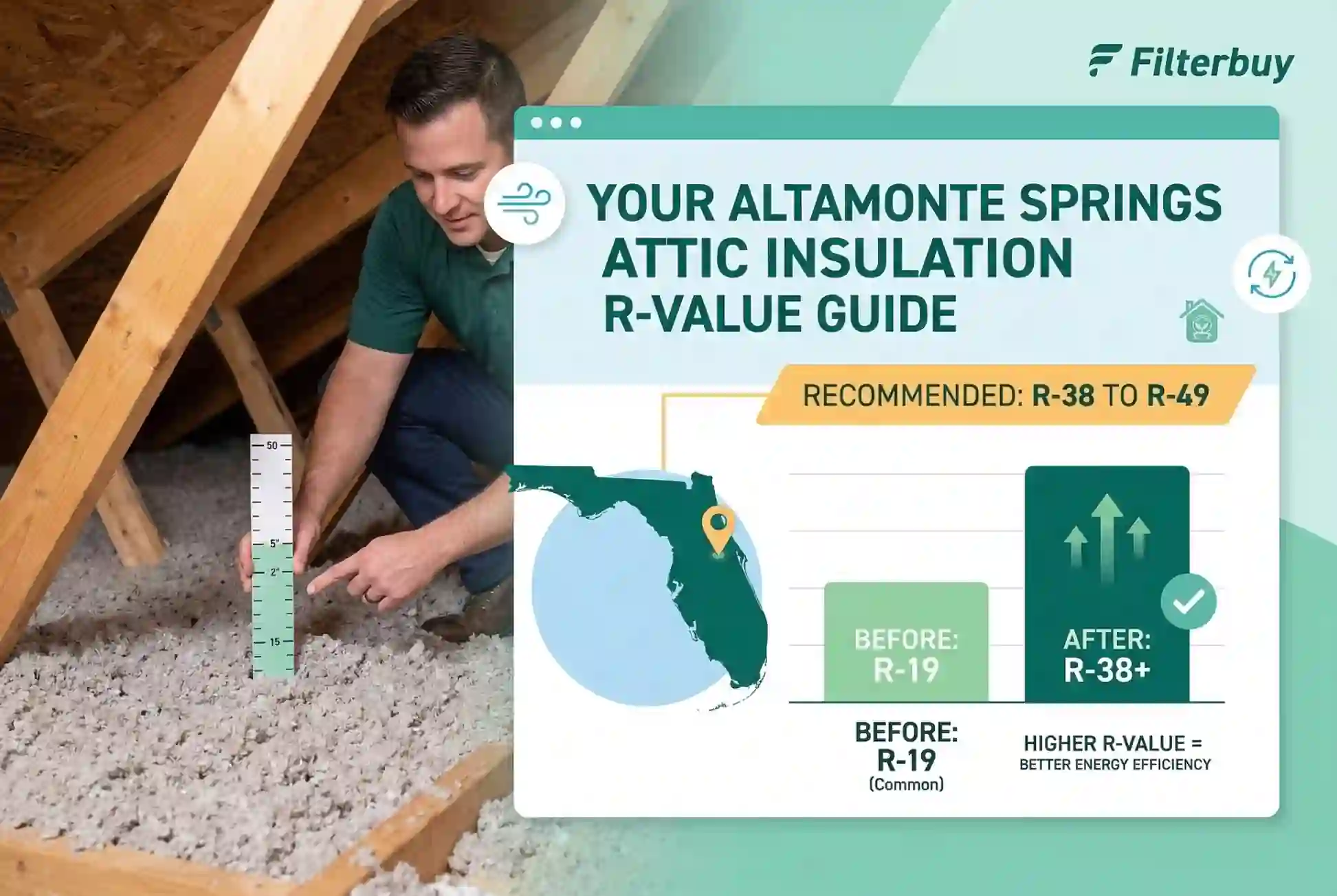
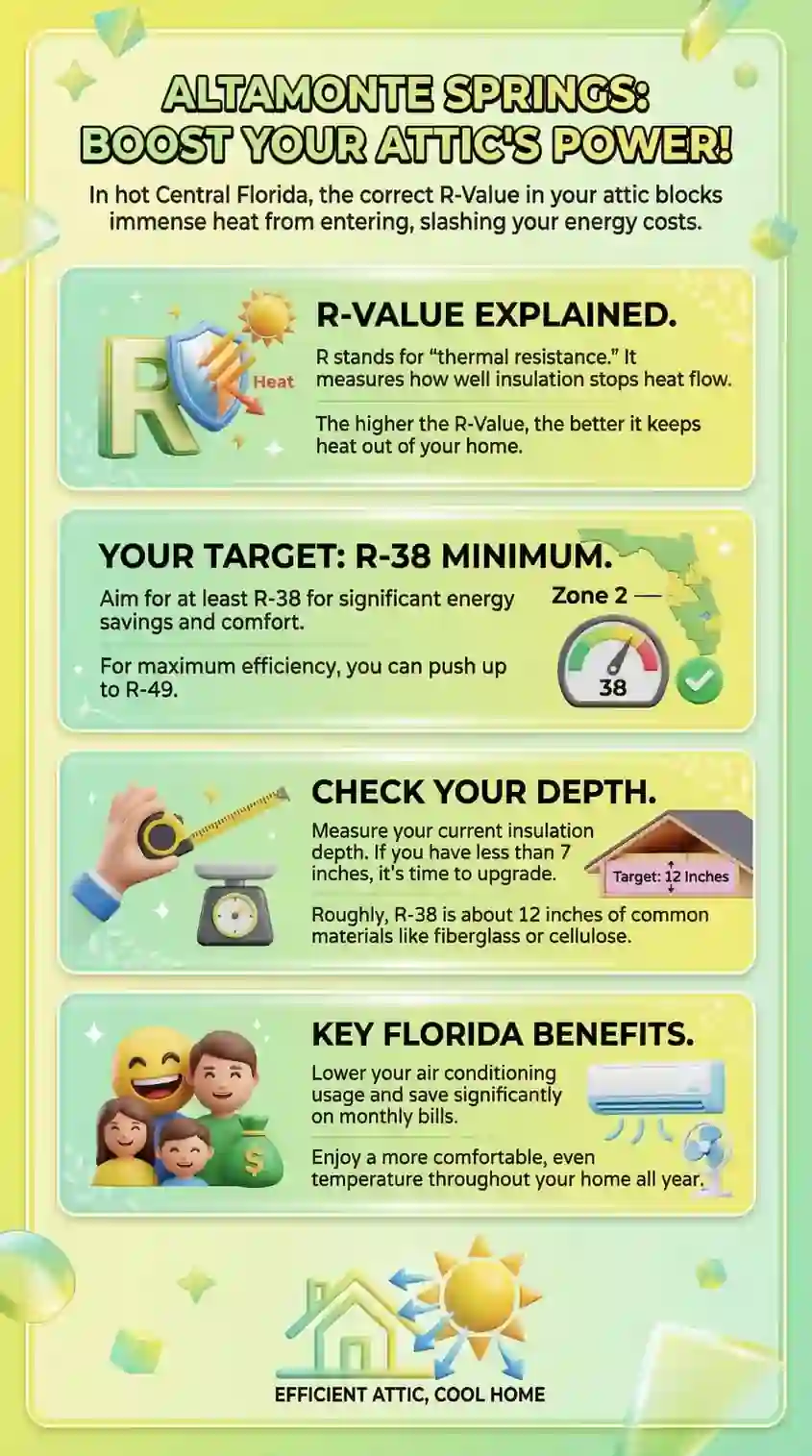
For homes in Altamonte Springs (Climate Zone 2), you need a minimum of R-38 — but in our experience, upgrading to R-49 or R-60 is where homeowners actually start feeling the difference on their utility bills.
This page guides homeowners looking for top insulation installation near Altamonte Springs FL, explaining the exact R-value targets for your attic, which insulation types perform best in Florida's heat and humidity, and how the right installation can help ensure your home stays comfortable and energy-efficient.
TL;DR Quick Answers
Top Insulation Installation Near Altamonte Springs FL
Altamonte Springs falls in DOE Climate Zone 2. Here is everything you need to know before scheduling attic insulation installation.
R-value requirements:
Minimum required: R-38
Recommended target: R-49
Best performance: R-60
Homes built before 1990: almost always need a full upgrade
Best insulation types for Altamonte Springs:
Blown-in fiberglass: best for most attic floors
Closed-cell spray foam: best for attics with duct systems
Fiberglass batts alone: rarely sufficient in Climate Zone 2
What it costs:
Average project: $1,500 to $3,000
Duke Energy Florida rebate: up to $800
Federal tax credit: up to $1,200
Potential combined offset: up to $2,000
Why attic insulation matters more in Altamonte Springs:
AC systems run 10 months out of the year here
Air conditioning accounts for 28% of Florida home energy use — 3X the national average
9 out of 10 homes are under-insulated
An under-insulated attic is the most common reason a properly sized AC system still can't keep up
What to do first:
Measure your current insulation depth
Complete a Duke Energy Home Energy Check before scheduling installation
Verify your contractor works to Florida Building Code R-38 minimum
Ask about blown-in fiberglass or closed-cell spray foam for Florida's climate
Top Takeaways
R-38 is the minimum — R-49 to R-60 is where you feel the difference. Meeting code is the starting line, not the finish line. In Climate Zone 2, upgrading beyond the minimum is where real comfort and real savings begin.
9 out of 10 homes are under-insulated — and most homeowners don't know it. The attic is out of sight and out of mind. It's also the single biggest factor driving high cooling bills and premature AC wear in Altamonte Springs.
Florida households spend 3X the national average on air conditioning. An under-insulated attic doesn't just waste a little energy here. It compounds a cooling burden that runs 10 months out of the year.
Money is available — but only if you act in the right order. Duke Energy Florida offers up to $800 in rebates. Federal tax credits cover 30% of material costs up to $1,200. Both require specific steps before installation begins.
The attic is almost always the problem — not the equipment. After years of servicing homes across Central Florida, the most common cause of an overworked AC system isn't the unit itself. It's the under-insulated attic it's been fighting against for years.
Why R-Value Matters More in Altamonte Springs Than Almost Anywhere Else
R-value measures how well insulation resists heat transfer. The higher the number, the harder heat has to work to move through it. In most of the country, attic insulation is primarily about keeping heat in during winter. In Altamonte Springs, the problem runs year-round — and it runs in both directions.
During summer, attic temperatures in Central Florida regularly exceed 150°F. Without adequate insulation, that heat radiates directly into your living space, forcing your AC to fight a battle it was never designed to win alone. What we consistently see in homes we service is that inadequate attic insulation is the single most common reason a newer, properly sized AC system still can't keep up, making proper air sealing and insulation a critical part of maintaining indoor comfort and efficiency.
Altamonte Springs R-Value Requirements by Home Type
Altamonte Springs sits in DOE Climate Zone 2, which carries specific insulation benchmarks. Here's what we recommend based on what we've seen in homes across the area:
No existing insulation: Target R-38 to R-60
Existing insulation under R-11: Add insulation to reach R-49 to R-60
Existing insulation between R-11 and R-22: Top off to reach R-38 minimum
Existing insulation at R-22 or above: You're at baseline — but upgrading to R-49 still delivers meaningful energy savings in Florida's climate
Pro Tip: Homes built before 1990 in Altamonte Springs almost always fall short of current recommendations. We rarely enter an attic in a pre-1990 home and find insulation performing at the level the homeowner assumes.
Best Insulation Types for Florida's Heat and Humidity
Not all insulation performs equally in Central Florida's climate. The high humidity here creates a secondary challenge that homeowners in cooler, drier states simply don't face — moisture infiltration. Here's how the most common options stack up:
Blown-in fiberglass: Our most commonly recommended option for attic floors in this area. It installs quickly, resists moisture, and achieves high R-values without adding structural load.
Blown-in cellulose: A strong performer for R-value per inch, but requires careful installation in humid climates to prevent moisture retention over time.
Spray foam (closed-cell): The premium choice for unvented attic assemblies or homes with duct systems running through the attic. Closed-cell spray foam acts as both insulation and vapor barrier — a major advantage in Florida's climate. Higher upfront cost, but significant long-term HVAC savings.
Fiberglass batts: Common in older homes but rarely sufficient on their own in Climate Zone 2. We typically see batts paired with blown-in as a top-up solution.
How to Check Your Current Attic R-Value
You don't need a professional to get a baseline reading. Here's what we tell homeowners to do before calling us:
Locate your attic access and look at the insulation depth. Most blown-in fiberglass achieves roughly R-3 per inch. Blown-in cellulose runs about R-3.5 per inch.
Check for coverage gaps. Insulation that's been pushed aside near the eaves, over can lights, or around attic hatches is a common source of significant heat loss that often goes unnoticed.
Look for your home's original insulation label. Many attics still have the contractor's installation card stapled near the access hatch, showing the original R-value and installed depth.
Note any signs of moisture or compression. Compressed or water-damaged insulation loses R-value significantly — sometimes to the point where it's performing well below its labeled rating.
When to Call a Professional
A DIY inspection gives you a starting point. But there are situations where we strongly recommend a professional attic assessment before adding insulation:
Your ducts run through the attic. Leaky attic ducts can pull conditioned air directly into unconditioned space — adding more insulation on top of a duct problem won't solve your comfort or energy issues.
You've noticed uneven cooling room to room. This often signals an air sealing issue that needs to be addressed before insulating.
Your home is older than 1978. Older attic insulation in Central Florida homes occasionally contains materials that require professional evaluation before disturbance.
You're planning a roof replacement. This is the ideal time to assess and upgrade attic insulation with the least disruption and best access.
After working in homes across the Altamonte Springs area, one thing is clear: the homeowners who take their attic insulation seriously are the same ones whose HVAC systems last longer, run quieter, and cost less to operate every single month.
"In my experience servicing homes across Altamonte Springs, the attic is almost always the last place homeowners look — but it's almost always the first place we find the problem. A 150°F attic working against a properly sized AC system is like leaving your front door open all summer. No equipment upgrade fixes that. Proper insulation does."
Essential Resources
After assessing attics across Altamonte Springs, we've learned that the homeowners who get the best outcomes — and the best value — are the ones who walk into the process informed. These are the seven resources we point our neighbors to before they schedule a single appointment.
1. Confirm Your R-Value Target Before You Call a Single Contractor
U.S. Department of Energy — Insulation Guide This is the federal benchmark we reference on every Altamonte Springs job. Before any contractor tells you what your home needs, verify it here yourself — it takes five minutes and puts you in control of the conversation. https://www.energy.gov/energysaver/insulation
2. Find Out Exactly Where Your Upgrade Dollars Have the Most Impact
ENERGY STAR — Recommended Home Insulation R-Values The EPA's interactive climate zone tool identifies the highest-return insulation improvements for homes in Central Florida. We recommend this to every homeowner before they request a quote — it helps you ask the right questions and spot when a bid doesn't add up. https://www.energystar.gov/saveathome/seal_insulate/identify-problems-you-want-fix/diy-checks-inspections/insulation-r-values
3. Know What Florida Law Requires Before You Pull a Permit
Florida Building Code — Energy Conservation, 8th Edition (2023) Every Filterbuy HVAC Solutions installation in Altamonte Springs is completed to code — no exceptions. This is the current Seminole County standard we work from. If a contractor can't speak to these requirements, that's a red flag worth paying attention to. https://www.seminolecountyfl.gov/docs/default-source/pdf/FormR402-2023ada.pdf
4. Don't Leave Duke Energy Money on the Table
Duke Energy Florida — Attic Insulation Rebate Program Many of the Altamonte Springs homeowners we work with don't realize Duke Energy offers up to $800 back on qualifying attic insulation upgrades — but only if you complete a free Home Energy Check before the work begins. We've seen too many homeowners miss this step and lose that rebate. Don't let that happen to you. https://www.duke-energy.com/home/products/home-energy-improvement/attic-insulation-upgrade?jur=FL01
5. Claim Up to $1,200 Back on Federal Taxes for Your Insulation Upgrade
IRS — Energy Efficient Home Improvement Credit (Section 25C) Qualifying attic insulation materials are eligible for a 30% federal tax credit up to $1,200. This is money most homeowners leave unclaimed simply because they didn't know it existed. Review the eligibility requirements and file Form 5695 — it's straightforward, and the savings are real. https://www.irs.gov/credits-deductions/energy-efficient-home-improvement-credit
6. Stack Your Savings: Federal Tax Credits and Local Rebates in the Same Year
ENERGY STAR — Federal Tax Credits for Energy Efficiency One thing we always tell homeowners: the Duke Energy rebate and the federal tax credit aren't mutually exclusive. This ENERGY STAR guide shows exactly how to combine multiple incentives in the same tax year. Understanding how to layer these programs can dramatically reduce your total out-of-pocket cost. https://www.energystar.gov/about/federal-tax-credits/insulation
7. Understand Why Most Older Altamonte Springs Homes Fall Short of Current Code
GreenBuildingAdvisor — Understanding the 2021 IECC Attic Insulation Requirements In our experience, homes built before 2021 in this area almost always fall short of what the updated code now requires. This expert analysis explains exactly why — and what the current Climate Zone 2 standards mean for your home. If your house is more than 15 years old, this is required reading before you schedule an assessment. https://www.greenbuildingadvisor.com/article/understanding-the-energy-code-the-2021-iecc-attic-insulation-requirements
These trusted resources help Altamonte Springs homeowners make informed decisions when choosing the best insulation installation, covering proper R-value targets, Florida building code requirements, available rebates and tax credits, and the insulation strategies that perform best in Central Florida’s heat and humidity.
Supporting Statistics
We don't recommend attic upgrades based on guesswork. Every assessment we conduct in Altamonte Springs is informed by federal research that shapes building codes, utility rebate programs, and energy efficiency standards. Here's what the data confirms — and what we see in homes across this area every day.
1. 9 Out of 10 U.S. Homes Are Under-Insulated — And Altamonte Springs Is No Exception
The EPA's ENERGY STAR program reports roughly 90% of U.S. homes lack adequate insulation.
That number tracks with what our technicians find in Altamonte Springs attics every week.
Most homeowners assume their insulation is performing. Most of the time, it isn't.
Homes built before 1990 are the most at risk — original insulation has often compressed, shifted, or was never installed to today's standards.
Source: EPA ENERGY STAR — energystar.gov/saveathome/seal_insulate/why-seal-and-insulate
2. Proper Attic Insulation Can Cut Your Cooling Bill by Up to 15%
The EPA estimates homeowners can save an average of 15% on heating and cooling costs by air sealing and adding attic insulation.
After completing upgrades across Altamonte Springs, we consistently hear from homeowners that their system runs less and their rooms feel more even.
In Florida's cooling-dominated climate — where AC runs 10 months out of the year — that 15% represents real, recurring savings that compound every month.
Source: EPA ENERGY STAR — energystar.gov/saveathome/seal_insulate/rule_your_attic
3. Florida Households Spend More Than 3X the National Average on Air Conditioning
Nationally, air conditioning accounts for roughly 9% of total home energy use.
In Florida, that figure climbs to 28% — more than triple the national average, according to EIA data.
An under-insulated Altamonte Springs attic doesn't just cost a little extra to cool. It forces an already-stressed AC system to compensate for heat radiating through the ceiling all day.
That compounding load is exactly why getting your R-value right matters more here than in almost any other state.
Source: U.S. Energy Information Administration — eia.gov/pressroom/releases/press535.php
4. The Attic Is Where 50–70% of Home Energy Waste Begins
The U.S. Department of Energy identifies heating and cooling as 50 to 70% of energy used in the average American home.
Inadequate insulation and air leakage are cited as the leading causes of that waste.
In every Florida home we service, the attic is ground zero for this problem — not the walls, not the windows.
We've seen well-maintained, newer AC systems struggle in homes where the attic hasn't been touched in 20 years. The equipment wasn't the problem. The attic was.
Source: U.S. Department of Energy — energystar.gov/sites/default/files/asset/document/Insulation%20Fact%20Sheet.pdf
Final Thought & Opinion
After assessing homes across Central Florida for years, one pattern is undeniable: the attic is the most overlooked, most impactful, and most misunderstood part of the home.
Homeowners invest in new AC systems, smart thermostats, and window upgrades. But when we find compressed, decades-old insulation sitting at R-11 in a home that needs R-49, no equipment upgrade fixes that gap. The system is fighting physics. And physics wins every time.
What makes Altamonte Springs different from most of the country:
Your AC doesn't get a break here. It runs through March. It runs through November.
It runs on a 68°F January afternoon when the sun has baked your attic to 120°F by midday.
That sustained thermal load demands insulation that meets the moment — not insulation that was adequate in 1987.
Three things we see consistently in homes across this area:
Under-insulated attics don't just waste energy — they wear out equipment. We've seen AC systems replaced prematurely in homes where the real culprit was never addressed. A new unit in a poorly insulated attic is an expensive short-term fix.
The savings are not theoretical. The EPA's 15% cooling cost reduction estimate is conservative in our experience. Homes upgrading from R-11 to R-49 often exceed that benchmark — especially where insulation has degraded significantly over time.
Most homeowners don't know what's up there. The attic is out of sight and out of mind until something goes wrong. A 15-minute assessment can reveal the single most impactful improvement available to your home.
The bottom line:
Altamonte Springs is one of the most thermally demanding climates in the United States.
Your attic is either working for you or against you.
Based on what we see every day — it's working against most homeowners right now.
Getting that fixed isn't complicated. It doesn't require a major renovation. It requires the right R-value, the right materials, and an installation done correctly the first time. That's exactly what we do.
FAQ on Top Insulation Installation Near Altamonte Springs FL
Q: How do I know if my Altamonte Springs home needs new attic insulation?
A: The attic is the last place homeowners look — but the first place we find the problem.
Warning signs to watch for:
Rooms that never cool evenly regardless of thermostat settings
An AC system that runs constantly without reaching temperature
Energy bills climbing without a clear explanation
Quick DIY check:
Grab a flashlight and measuring tape
If insulation sits at or below your floor joists, you're under-insulated
Less than 10 inches of depth means you fall short of Climate Zone 2 requirements
Homes built before 1990 are highest risk — original insulation rarely performs at its rated R-value
Q: What R-value do I need for attic insulation in Altamonte Springs, FL?
A: Florida Building Code sets R-38 as the minimum for Climate Zone 2. Based on what we see in homes across this area, R-38 is where the conversation starts — not ends.
R-38: Code minimum — adequate for newer, well-sealed homes
R-49: The sweet spot for most Altamonte Springs homes
R-60: Best for older homes or attics with duct systems running through them
Florida's 10-month cooling season means every R-value point above minimum keeps paying back month after month.
Q: What type of attic insulation works best in Altamonte Springs' climate?
A: Florida's heat and humidity create demands most of the country doesn't face. Based on installations across Central Florida, here's how the main options stack up:
Blown-in fiberglass: Our most-recommended solution. Fast to install, moisture-resistant, achieves high R-values without adding structural load.
Closed-cell spray foam: Best for attics with duct systems. Acts as both insulation and vapor barrier — a critical advantage in Florida's humidity.
Fiberglass batts alone: Rarely sufficient in Climate Zone 2. Best used as part of a combined approach, not a standalone solution.
Q: How much does attic insulation installation cost in Altamonte Springs, FL?
A: Most projects in this area run between $1,500 and $3,000 depending on attic size, current insulation levels, and material type.
Available incentives that reduce that cost:
Duke Energy Florida rebates: up to $800 for qualifying upgrades
Federal tax credit: 30% of material costs up to $1,200
Combined potential offset: up to $2,000 before monthly energy savings begin
One critical reminder: complete your Duke Energy Home Energy Check before scheduling installation. Missing that step means losing the rebate entirely.
Q: How long does attic insulation installation take in Altamonte Springs?
A: Most installations in this area are finished in a single day.
Here's what the process looks like:
Inspection — Assess current insulation levels and identify gaps
Preparation — Protect surrounding areas before work begins
Installation — Install to correct R-value depth per Florida Building Code
Final Check — Verify coverage and clean up completely before leaving
Projects requiring old insulation removal may extend to a second day
Disruption to your home is minimal either way
Comfort improvement begins immediately after installation is complete
In What R-Value Do I Need for My Attic in Altamonte Springs?, we explain that proper attic insulation is one of the most effective ways to reduce heat gain, stabilize indoor temperatures, and prevent your HVAC system from overworking during Florida’s long cooling season. When attic insulation is correctly matched to local climate recommendations, homeowners typically see steadier comfort and improved system efficiency—but airflow and filtration still play an important supporting role. Keeping return airflow clean with the right filter, such as a 13x21.5x1 pleated furnace filter or a 12x18x1 MERV 8 pleated HVAC air filters 2-pack, helps maintain proper system performance once insulation improvements are made. For homeowners comparing replacement options or checking sizing before a filter change, listings like a 13x21.5x1 MERV 8 pleated HVAC air filter can help ensure the system continues moving air efficiently after attic upgrades reduce the heat load on the home.
